Stop comparing yourself to others… do this instead
Artists do it.
Musicians do it.
And game designers do it.
We are constantly comparing ourselves to others in our industry or profession, looking at their accomplishments or output, concluding that we’re just not as good as them.
This is a defeating attitude that won’t do any of us any good.
So, let’s talk about why you shouldn’t be comparing yourself to others and what the healthier thing is to do.
Why it’s harmful to be comparing yourself to others
It’s so easy to look at the accomplishments of those who have come before us and feel that we just don’t measure up.
Maybe you’ve been working on your game for a couple of years and are still not done. Perhaps you haven’t been able to find an interested publisher or you just can’t get over that last hurdle that takes your game from great to truly amazing.
You see others getting their games published. You see other designers with dozens of fantastic games on the shelves, making a living doing what they love.
Maybe you’re thinking you’re just not cut out for this and won’t ever be as good as any of them.
But here’s the thing. They were once exactly where you are now.
They didn’t just create a series of games that were all hits. Their first prototypes weren’t all perfect.
In fact, their early days of designing were all about learning and getting better. For most of them, their first game (or even their first handful of games) was probably terrible. Even the games that did become hits weren’t perfect on their first playthrough. I’m sure that Gloomhaven was a hot mess at first. And so was Wingspan. And so was just about any published game that you can think of.
The problem is, we’re only seeing the end product. The game that had been playtested and tweaked dozens or even hundreds of times until it became what it is today.
It’s like watching the 30-second highlight reel after a big game and ignoring all the fumbles, interceptions, and missteps that also happened during the course of the game.
None of these designers was an overnight success. Take Phil Walker-Harding for example. When I talked to him during the Board Game Design Virtual Summit, he admitted that he had been designing games for years and wasn’t making any traction. He was on the verge of quitting when his first game got picked up.
Just think of where we’d be if he had thrown in the towel. We wouldn’t have Barenpark, Imhotep, Gizmos, Silver & Gold, or the huge hit Sushi Go.
It takes time. Every designer who has “made it” had to pay their dues and put in a lot of hard work. They had to make bad games before they made good games. You can’t compare yourself to someone who has been doing this for such a long time when you’re just starting out, relatively speaking. It just isn’t fair to you.
You need time to grow as a game designer.
Compare yourself instead to… yourself
If you’re going to compare yourself to anyone, it should be yourself.
Ok, you’re probably thinking I’ve gone crazy, right? What’s Joe even talking about here?
What I mean is comparing yourself to your former self. How good are you as a game designer compared to how good you were a week ago? A month ago? A year ago?
It’s all about making progress on your own terms.
Are you learning from your playtests and other designers?
Are you applying these learnings to make your games better and to make your current game better than your last one?
You should be growing as a game designer. Taking on new ideas and challenging yourself. Ask yourself, “How can I make this game better?” Then do the work to make it the best it can be.
Move from creating an expansion for an existing game to making a small card game. Then make a bigger game. Make a campaign or legacy game. Whatever interests you and stretches you creatively.
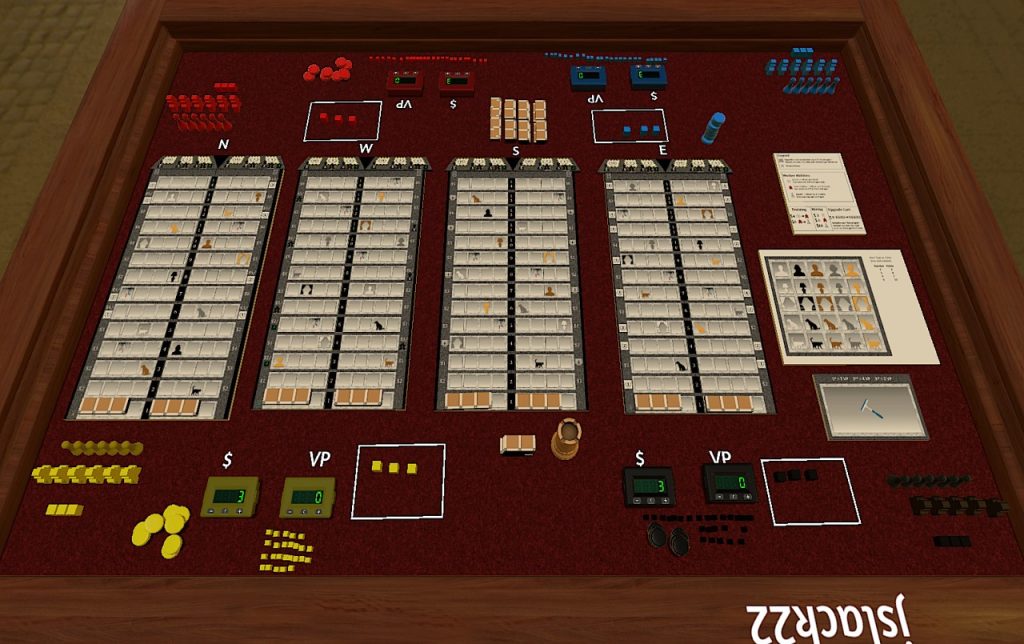
Years ago, I thought worker placement games were just ok, but they’ve never really drawn me in. Maybe I just haven’t played the right one yet, but I feel there is a sameness to many of them. So, the worker placement game I made had to be different.
Instead of the standard “place one worker and get a thing” most of us are used to, I wanted to introduce more interaction, as well as some inter-dependencies. So, you’ll always gain something but you’re not always guaranteed to get the exact thing you want. It all depends on how you and the other players place their workers. This is how Window Washers operates and players have really been enjoying this twist on worker placement.
It even went on to win the Canadian Game Design Award!
Could I have created this as my first game? No way! But ever since I first set out to create my first game, I have played hundreds of different games, both published and prototypes. I’ve created dozens of my own games. Many of them will never see the light of day but each and every one of them helped to make me a better game designer.
Oh, and after now having played some other fun worker placement games with interesting twists of their own, like T’zolkin, Viticulture, and Lost Ruins of Arnak, I have a much better appreciation for this mechanic!
Wrapping it up
Keep working on your own game(s) and improving your game design chops. That’s the only way to get better as a game designer. Stop comparing yourself to others like the Reiner Knizias of the world and work on making yourself a better game designer. Your future fans will thank you for it. 😊
How have you seen yourself evolve and grow as a game designer? What was your first game like, and how have you improved since then?
Please leave a comment and share your story!
8 comments
Lena Drake
Great post! As for me, I love worker placement, and your take on it sounds so intriguing, I hope to play it some day! 😀
Joe Slack
Thanks, Lena! I’m sure we can make that happen one day. 🙂
Scott Hengehold
I wish more designers could hear this. I personally like to hang up my old prototype boards in my office. Not because I think they are beautiful art, but because they are terrible! It’s a constant reminder of how I have improved not only in art but it method and layout as well. I keep a running tally of how I personally have improved vs myself not how I measure up to great designers or even how I measure up to good designers. If I get down on some project that has me stumped, I glance around my office and say “Look how far I’ve come.”
Joe Slack
Thanks so much, Scott! I’m glad this resonated with you.
Bill Murphy
I remember changing many games that I played as a child. My tween and teen years were much the same, though that was more expected in role-playing games. Even, at the time, miniature battle games were incorporating more role-play elements.
One of my early designs was, of course, a chess variant. If I can recommend one thing to any new designer, don’t do this. It has been done to death. Many new designers create chess variants. I think mine was interesting, but looking back, I’m glad I never created the final product. My time was better spent finishing high school and college, growing my graphic design career, and playing many other games. Maybe I could get inspired by that older design, but not by making another chess variant.
Many new designers, especially those who love chess, do this. Instead, take the concepts and ideas from how you would twist chess into your idea for a game and then perhaps change the theme. Even if you still want an abstract game, take the chess elements out of it. You can have multiple pieces that move in various ways, and in my case, add card play that modifies how the pieces move or allows them to mimic other pieces. Why stick to chess?
If you have done something similar and you feel it’s right, stick to it, but twist it into your own distinct thing. Your own unique product will have deeper meaning for you, and that will show through in the final design.
Deep down, we know the difference between inspiration and blatantly taking an idea. Others will see it as well. Nothing truly new is made without mashing two or more things together, but you should try to come up with the most creative ways to do this. The key is making it your own: your take, your spin on an idea or two, pressed together in a vice. Voilà, a new, great thing!
This one you created, and it’s original. It still can feel like a cool thing that others understand; they feel comfortable, but not so comfortable that they could just go play the other thing. The hope is they get excited about the difference and how well the new elements work together.
This is how I feel we at BSGames have succeeded with our first couple of games. We learn from every project and move forward, with each new project becoming that much easier. Each time, we gain skills from our past struggles.
I do have games, or at least ideas, I’ve been working on for about a decade. If an idea isn’t ready, that’s alright. I’ll learn from my other projects, and when I get back to the decade old one, it will be better for it. I have learned that it is not bad to “fail” at a project; the learning process is what allows some sort of mistake, to evolve into an entirely different game. M
We pitched our game Survival of the Middlest to a publisher, and their feedback was that they didn’t like how the winner was calculated in different ways based on player count. We took some time and came up with a new game: Why Did the Average Chicken Cross the Road? – To Get to the Median -. (They like long game names about animals!) Its predecessor (Survival of the Middlest) did get a rework, adding a piece that tracks turns and acts as the games timer. This also helped the game have a clear end. The new piece could even be used as a “player” when calculating the score if there is an even number of players. This allows the game to always have an odd number of players, making it easier to calculate the player in the middle, hence the game’s name.
Full circle! Now we’re pitching two quite different games, both with borrowed card play. We feel they are quite different, but we’re biased. Haha!
Just got our second printing of our game Methemagician’s Duel. I love the 1st version of the game when it came out. This edition, yeas later is much better as it is focusing on the cartoon characters in the game. It is a better visual box. It’s now bilingual (French and English) and that was something we didn’t think hard enough about for the 1st edition. Truly feels Canadian. Good opportunity to add the award we received back in 2023 to the box. Same game, same rules, updated and better for it.
Enjoy the time making the game as much as playing it in its final edition. I wish everyone great success with all their projects.
Joe Slack
Thanks for sharing your journey, Bill! It’s been great seeing your successes with BS Games!
Bill
You inspire me constantly. Thanks for that.
Joe Slack
Thanks, Bill!